

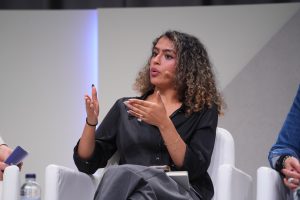
Last week, I attended Mobile World Congress in Barcelona with Ash Kapoor – Telstra Foundation’s Young Person-in-Residence – to be part of GSMA’s Ministerial Programme.
Ash along with young people from The Democratic Republic of the Congo (Jemima) and Burkino Faso (Gouba) amplified what its like growing up digital.
Across the week, we brought youth and tech insights into the room, learned from global leaders, and strengthened relationships with people working to keep children’s digital rights at the centre of responsible business.
Five days, full agenda – events, roundtables, panels, meetings, making digital content – here’s my youth highlights:

Roundtable discussion: Online Safety and Age-Assurance
Leaders from government, industry, civil society and international organisations came together to discuss online safety and age assurance and young people set the tone, keeping the conversation anchored in their lived experience.
In opening remarks, Jemima (UNICEF Youth Ambassador) spoke candidly about growing up online and outlined her ask of government, industry and regulators.
Ash shared her experiences and reflected on Australia’s recent social media access delays. The youth message was clear: build technology with young people, not for them.
As the discussion moved to age assurance and age-based restrictions, youth voices stressed that online safety is about equity, inclusion and rights – and that protection shouldn’t mean exclusion. Nothing about young people, without young people.
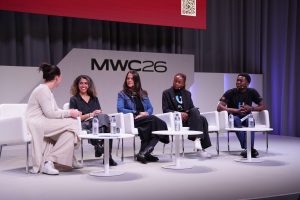
Panel: “Youth Unmuted: Defining Digital Wellbeing”
This session (part of the MWC #ChangeTheFace Summit) centred young people directly in conversations about the internet and their wellbeing. Breaking from the long‑standing pattern of speaking about youth rather than with them, the discussion highlighted that safe digital spaces are a prerequisite for genuine digital wellbeing.
“Children aren’t users to be managed, they are stakeholders to be listened to” – Ekin Björstedt, Secretary General Global Child Forum
Speakers emphasised that when young people fear harassment, scams or misuse of their data, their ability to learn, express themselves and participate fully online is fundamentally undermined. Digital wellbeing was framed not as a question of screen time, but as one of dignity, safety and respect in online environments.
“Digital wellbeing is about having a healthy and empowering relationship with technology …where the internet supports my growth, my civility and my ability to participate fully in society” – Gouba Abdoul Sofiane Romaric (UNICEF Youth Ambassador Burkino Faso
The session also tackled the debate around whether banning platforms is an effective way to protect children, with a clear message that protection should not mean exclusion.
“I think bans are not the right solution – protection should not mean exclusion – sure it can reduce risk but it removes information, education, skills” – Jemima Kasongo (UNICEF Youth Ambassador Democratic Republic of the Congo
Instead, youth panellists called for safer platform design, stronger digital education and smart, rights‑respecting regulation.
“When you can’t decipher what is true and not true online, this is the issue that young people are concerned about” – Ash Kapoor (Telstra Foundation Young Person in Residence)
The central conclusion: a safer internet cannot be designed without listening to the people who use it every day.

Panel: Access Denied! Best practices to safeguard people online
The “Access Denied!” session at #MWC26MP tackled how to protect users, especially young people, without undermining privacy, openness, or a globally interoperable internet.
Key takeaways: youth must shape policy; education and awareness are essential; age assurance needs stronger (not tick-box) frameworks; and AI-driven risks make safety-by-design and cross-sector collaboration even more urgent.
Natasha Jackson (GSMA) concluded that regulation alone isn’t enough – progress needs youth participation, smarter tools, global cooperation, and education at scale.

It’s easy to get swept up in the MWC “overwhelm” – back-to-back meetings, partners and vendors, late dinners, sprinting from one presentation to the next, product demos, launches and deals. The buzz was loud – “AI-native” networks built from the ground up (not bolted on), space as the next layer of mobile infrastructure, and an “Everywhere Network” that makes the case for shared global rules all featured strongly. The content and the pace confirms that the future is arriving all at once.
But the centre of this future isn’t just the tech – it’s responsible leadership and its young people. As products and services evolve, so does the duty to make them safe by design, and the tech sector still has much work to do. That work must include embedding children’s rights into innovation, communication and decision-making – not as an afterthought, but as a standard. We know that the digital world is shaping childhoods, with young people online earlier, for longer, and with greater exposure to both opportunities and harms. And we also know, progress only counts when responsibility keeps pace.