
- Alexandra Whitwam - Youth and Community Engagement Manager, Telstra Foundation
Digital skills are often talked about in terms of coding, cybersecurity, and STEM pathways, but ask a young person, and you’ll get a very different picture. In 2025, the Telstra Foundation Youth Advisory Council (the Council) set out to explore this gap: What if the digital skills that matter most to young people are completely different from what adults imagine?
Through a bold youth‑led research project combining creativity, data, experimentation, and hands‑on digital activities, the Council uncovered a richer, more human story about how young Australians build the skills they need to thrive in a digital world.
Why we decided to explore this
Young people aren’t passive digital consumers. They’re gamers, creators, entrepreneurs, collaborators, activists, sometimes all at once. Their digital lives are vibrant, complex, and deeply self‑directed.
The 2025 Australian Youth Digital Index showed that:
- 73.7% of young people taught themselves digital skills, mostly through trial and error, online communities, and curiosity.
- Fewer than half learned these skills at school or from family.
- 78% believe digital skills will be essential for their future careers.
The Digital Skills Project set out to understand these realities, not from an adult perspective, but through the lived experiences of young people themselves.
Youth led from the start
The project was co‑designed with our Council members (aged 12–18). They weren’t “participants”, they were co‑researchers, shaping every part of the project.
Digital interest activities
Co‑researchers chose activities that reflected their passions – from art and digital music production to VR game development, Minecraft world‑building, AI chatbot creation, and online business design. Over two weeks, they conducted self‑directed digital experiments and creative projects.

Dakota (17), Youth Advisory Council Member
Listen to Dakota’s music here – tip from Dakota you should listen to them in this sequence!
Mapping the digital skills timeline
Council members also created a timeline of when they first had key digital experiences. Ages 7–10 were pivotal for foundational skills, while more advanced skills like coding and AI typically began around 11–13.
Skills the Council identified
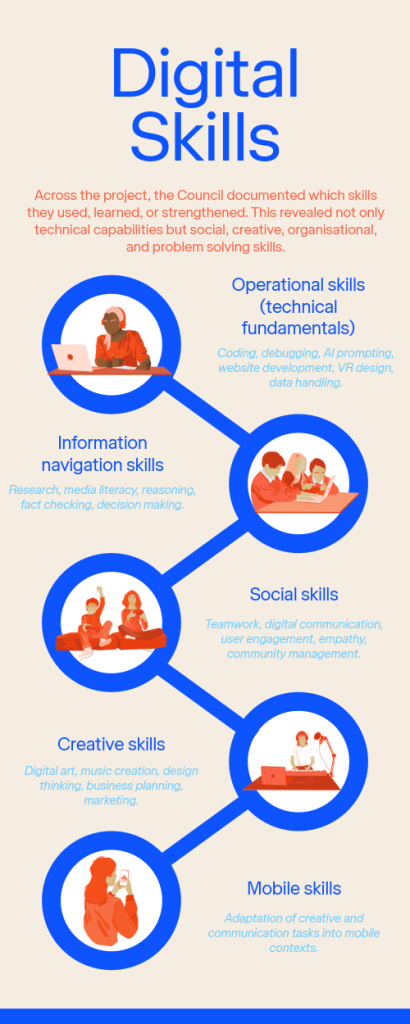
One striking insight?
Council members did not list many basic digital skills (e.g., using a browser, organising files), because they were so embedded they were kind of invisible. They assume everyone their age “just knows” them.
Ah ha moments
1. Digital skills are broader than adults think
Creativity, problem‑solving, critical thinking, and relationship‑building are central (not secondary) skills.
2. Young people learn from the internet, peers, and play
Trial‑and‑error, online tutorials, and shared exploration were more influential than formal education.
3. Access matters
Just like access to books builds literacy, access to digital tools builds digital capability.
4. Agency drives learning
Young people aren’t waiting to be taught, they are proactively exploring digital futures that interest them.
Why this project matters
The Council’s work shows that to prepare young Australians for rapidly evolving digital landscapes, we must:
- Recognise the full spectrum of skills they’re already developing
- Value digital play as legitimate skill‑building
- Invest in access, tools, and opportunities for youth‑led learning
- Partner with young people as co‑designers of digital futures
Their message is clear: young people aren’t just keeping up with digital change – they’re leading it. And when we listen to them, we get a truer picture of the skills our future workforce, creators, and innovators will need.
For more detail on the projects and work the Council did read the full report here.