
- Alexandra Whitwam - Youth and Community Engagement Senior Manager, Telstra Foundation
Building a more sustainable youth mental health system
Australia’s youth mental health system is under real and growing pressure. Demand continues to rise, services are stretched, and too many young people still face long waits or struggle to access support that works for them.
Meeting that challenge takes more than one‑off programs or short‑term fixes. It requires long‑term thinking including; new models of care, sustained investment, and services that can reach young people earlier, more flexibly and at scale.
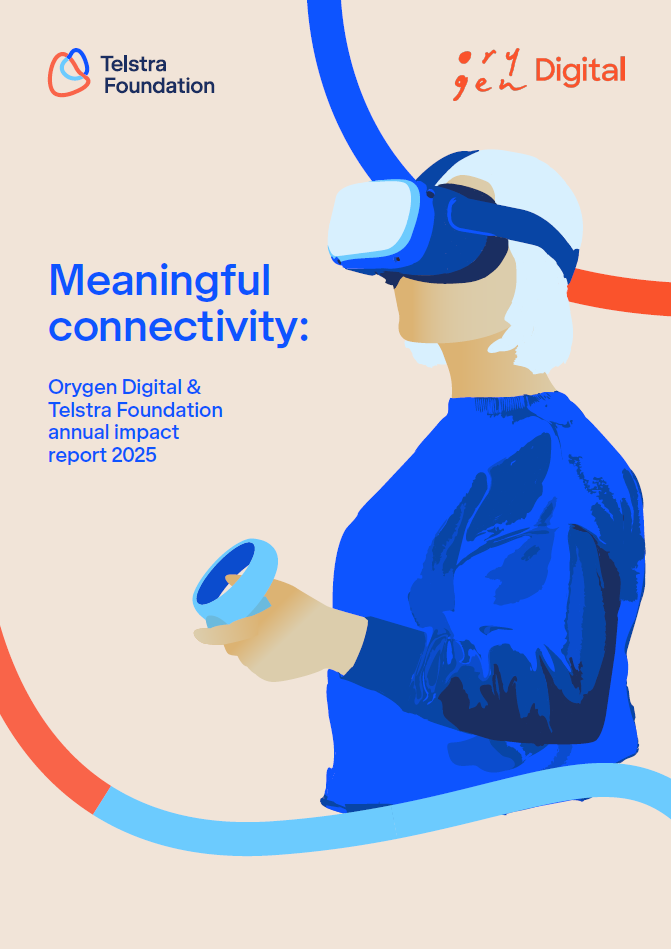
That’s the shared ambition behind the Telstra Foundation’s long‑standing partnership with Orygen Digital. And it’s why we’re proud to release the Orygen Digital & Telstra Foundation Annual Impact Report 2025.
This report doesn’t just capture a year of activity. It tells a longer story, one about what’s possible when organisations commit to working together over time to help shift how youth mental health support is designed and delivered.
Starting early – before it was obvious
Our partnership with Orygen Digital began in 2011, with an early investment in what would become MOST. At the time, digital mental health was still emerging. The evidence base was developing, and the idea that digital services could play a meaningful role in the mental health system wasn’t yet widely accepted.
What we shared, was a belief that digital support could strengthen the system, not by replacing face‑to‑face care, but by extending it. By offering young people more options, more continuity and more ways to access help when and where they needed it.
That belief has proven true over time. MOST has grown from a research‑led innovation into a nationally recognised service, unlocking significant research funding and government investment and becoming embedded within Australia’s youth mental health landscape.
As the system evolved, so did the partnership, expanding to include Mello and MindVR, and adapting in response to emerging needs, new evidence and changing expectations about what good support looks like for young people.
Young people are clear: they want support that is safe, personalised and readily available when they need it. They also want options – tools that can be used alongside clinical care, between appointments or before they’ve entered the mental health system.
- Professor Mario Alvarez Jimenez, Executive Director, Orygen Digital
Digital support as part of the system – not on the sidelines
One of the clearest lessons from this work is that digital mental health services are most effective when they’re treated as part of the system itself, not as add‑ons or stand‑alone solutions.
Across Orygen Digital’s services – MOST, Mello and MindVR – a shared approach underpins their impact: strong clinical evidence, meaningful youth and clinician co‑design, and a focus on safety, privacy and quality.
These tools support young people between appointments, alongside clinical care, or earlier, before distress escalates. In doing so, they help relieve pressure on already stretched services, while improving continuity and choice for young people navigating their mental health.
What this means for the system
Taken together, this work points to several important shifts in how youth mental health support can be delivered.
It shows that digital services can function as core infrastructure, helping the system reach more young people, earlier, and in ways that reflect how young people actually seek help today. It reinforces the value of early and flexible support in reducing downstream pressure on acute services. And it highlights why long‑term partnerships are essential if innovation is going to move beyond pilots and embed into everyday practice.
Sustained partnerships allow innovation to move beyond pilots and into the system itself, where it can reach more young people, earlier, and with real impact.
- Jackie Coates, CEO, Telstra Foundation
Why staying the course matters
System change doesn’t happen in neat funding cycles. It takes time, trust and a willingness to invest through uncertainty.
Over more than 15 years, the partnership between the Telstra Foundation and Orygen Digital has supported research, evaluation, learning, iteration and scale, not only during moments of visible success, but through the quieter, essential work of building services that last.
That long‑term commitment has created space to test ideas, respond to evidence, adapt to changing needs and embed digital services into a complex and evolving mental health system.
Looking ahead
As demand for youth mental health support continues to grow, the question is no longer whether digital services have a role to play but how well they are integrated into the system as a whole.
The Orygen Digital & Telstra Foundation Annual Impact Report 2025 reflects what can be achieved when digital solutions are built on evidence, shaped by young people, and supported through sustained partnership.
We’re proud of what this collaboration has contributed so far, and committed to continuing the work of strengthening access, sustainability and outcomes for young people navigating their mental health.
Read the Orygen Digital & Telstra Foundation Annual Impact Report 2025