
- Margaret O'Brien - Community Partnerships and Impact Senior Manager, Telstra Foundation
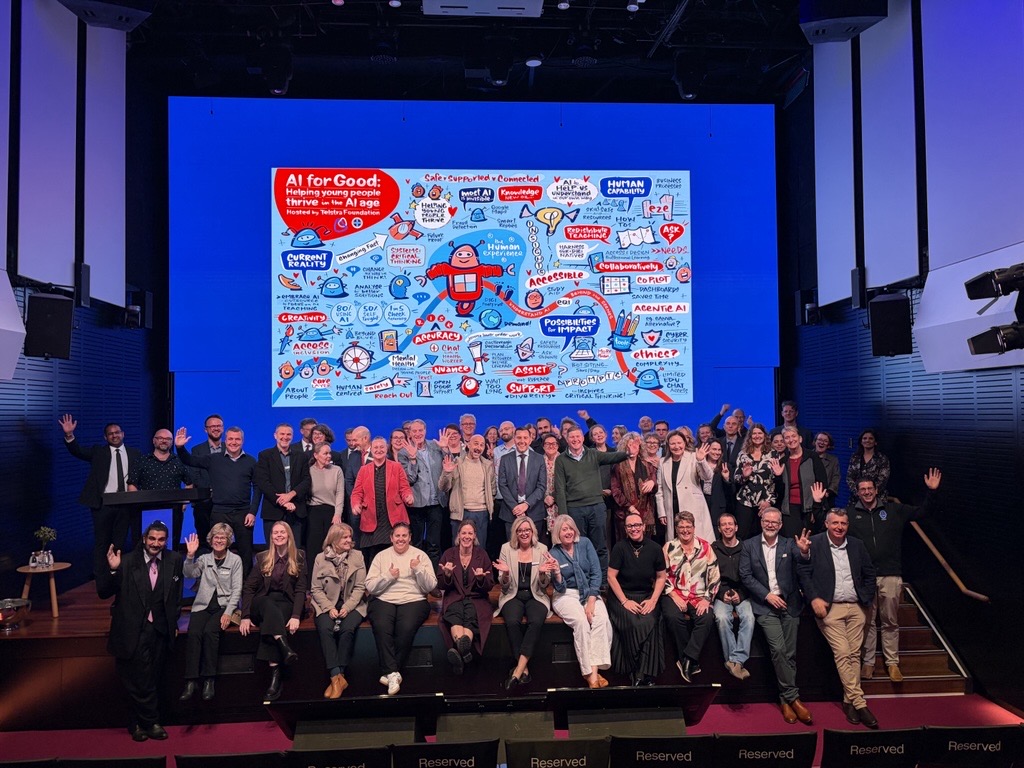
More than 80 secondary school principals gathered at the Telstra Customer Insight Centre in Sydney recently for the NSW Secondary Principals’ Council Professional Learning Day, exploring one of the most important questions facing education today: how do we prepare young people to thrive in an AI-enabled world?
The theme of the day, Leading in an AI Disrupted World, brought together experts from education, technology, mental health and, importantly, young people themselves. While much of the public conversation about artificial intelligence focuses on risks and disruption, our contribution centred on a different question: what are the possibilities for impact when AI is used thoughtfully, responsibly and in service of people?
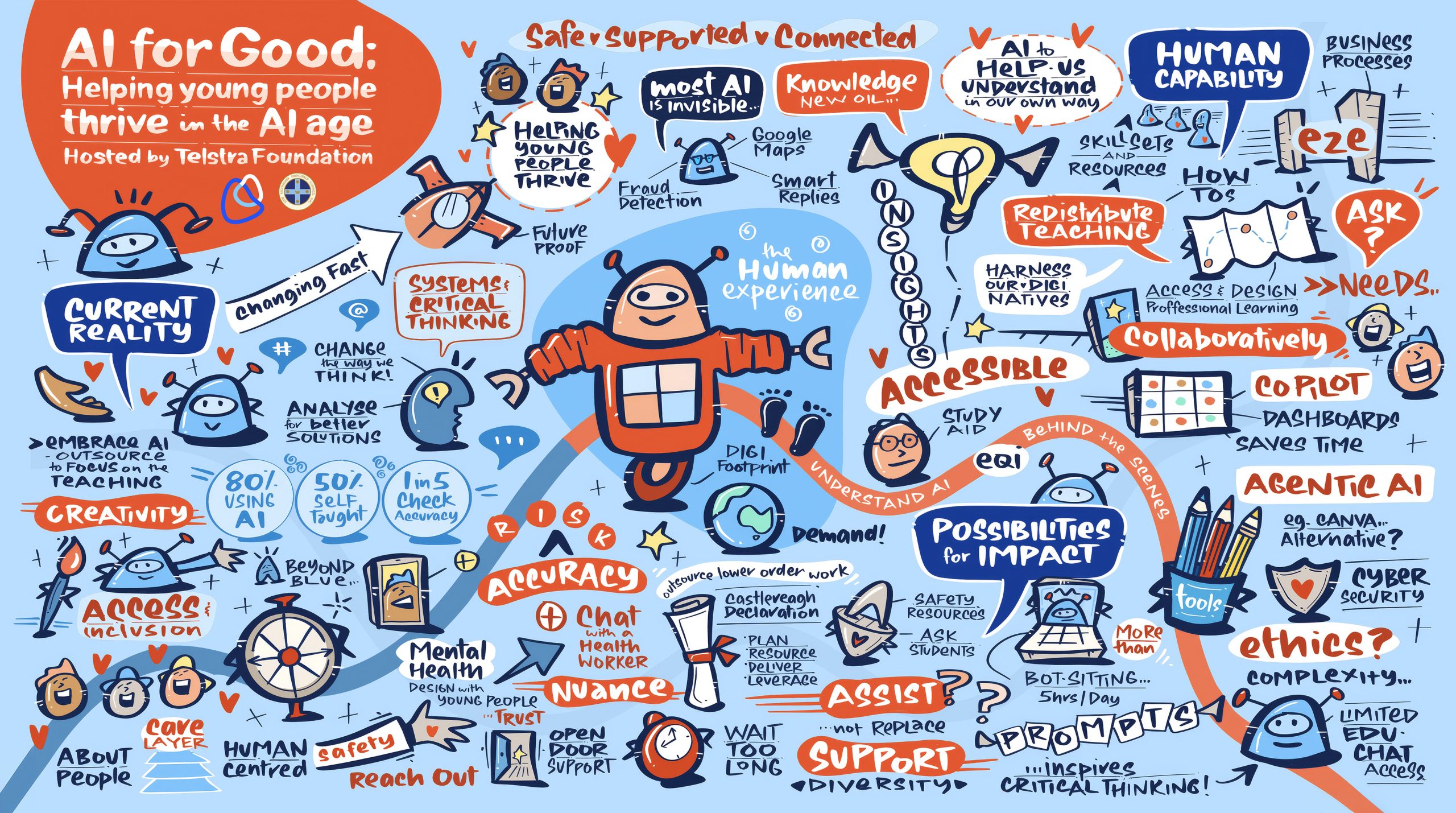
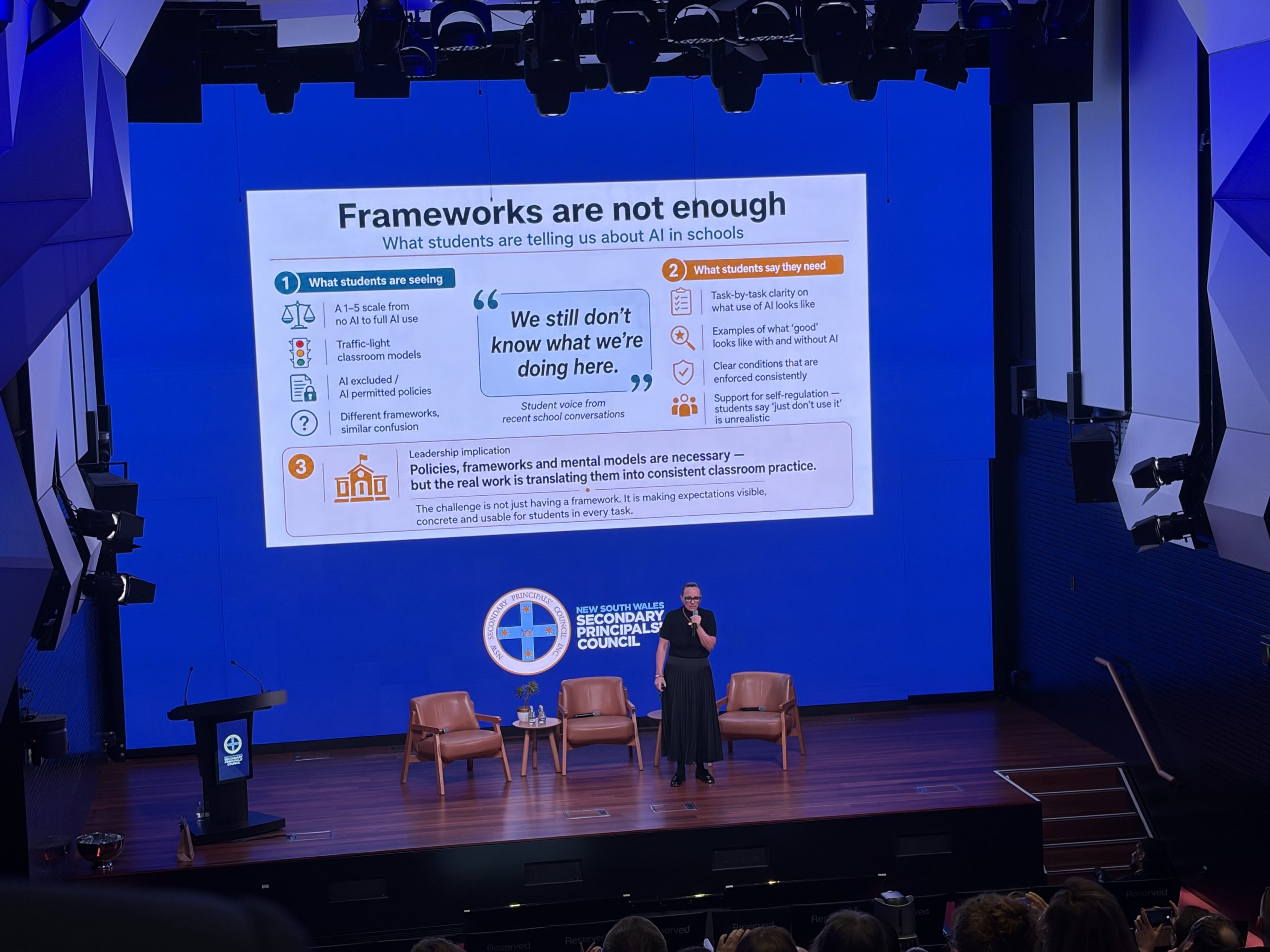
Moderated by Margaret O’Brien, the Telstra Foundation session – AI and the Possibilities for Impact, was designed as an interactive experience rather than a traditional panel discussion. Participants were invited to reflect, share ideas and consider how AI might help address real challenges faced by students, teachers, school leaders and communities.
Starting with the problem, not the technology
One of the key messages of the session was that AI should not be viewed as the starting point. Instead, principals were encouraged to begin with a problem or opportunity they wanted to address and then consider whether AI might be a useful tool or lever to help.
Using a specially designed “Problems as Opportunities” worksheet, participants explored challenges from four perspectives: student experience, teacher experience, school administration and parent/community engagement.
From personalised learning support and reducing administrative burden, through to strengthening family engagement and community connections, the room quickly filled with practical examples of how technology could support people to do what they do best.
Young people are already using AI. The real challenge is trust and support.
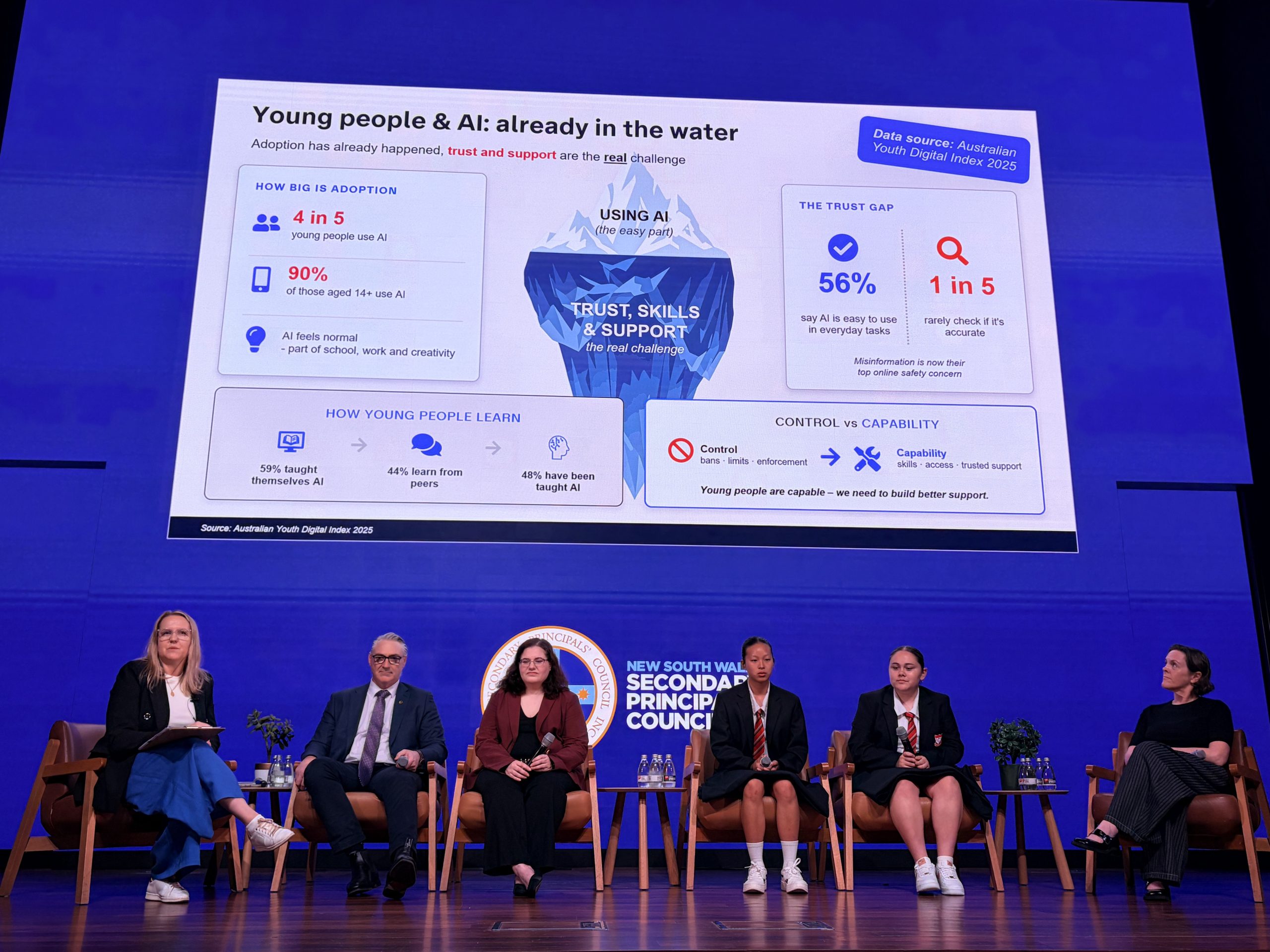
The conversation was grounded in findings from the Australian Youth Digital Index (AYDI), one of Australia’s largest studies into young people’s digital lives. AYDI 2025 surveyed 4,764 Australians aged 8-25 and found that four in five young people are already using AI tools. The challenge is no longer adoption. The challenge is ensuring young people have the skills, support and critical thinking required to use these tools well.
During the session, principals reflected on findings showing that while AI use is widespread, many young people are teaching themselves how to use these tools and only one in five regularly check the accuracy of AI-generated information.
The discussion challenged educators to move beyond a mindset of control and restriction toward one focused on capability building, critical thinking and trusted support.
Four perspectives. One shared responsibility.
The panel brought together diverse perspectives from across the ecosystem.
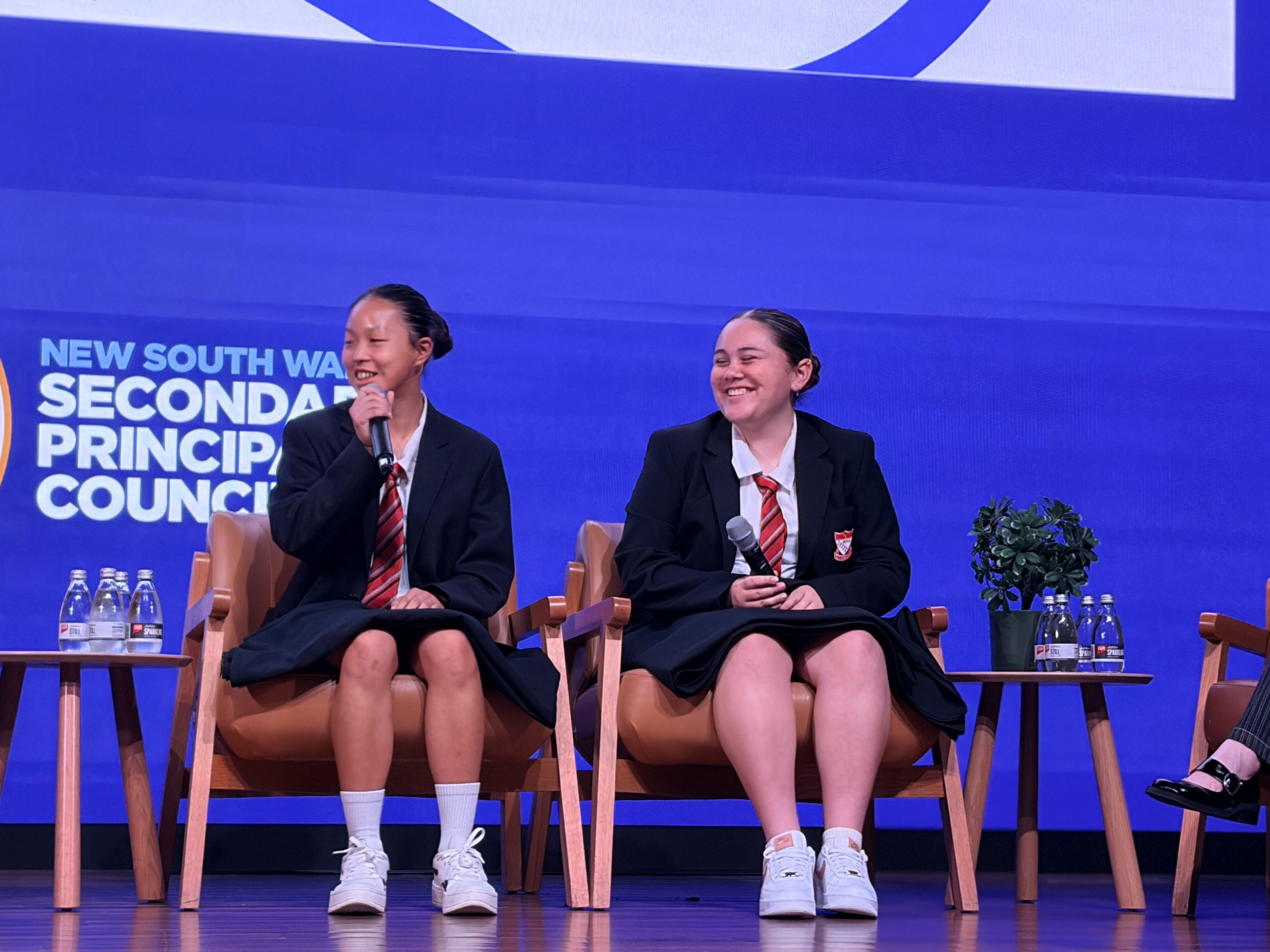
Year 10 Students Chloe Briggs and Liz Wong from Wyong High School shared insights into how young people are navigating AI today and discussed the importance of retaining creativity, teamwork and independent thinking. They spoke about wanting to help their peers understand how to use AI responsibly.
Tim Lloyd, Principal of Plumpton High School and a signatory to the Castlereagh Statement, explored the leadership challenge facing schools and the importance of a coordinated, cross-sector response to AI in education. He spoke to the need for long-term thinking, teacher empowerment and community trust.
Dayle Stevens, Executive of AI Engagement and Advancement at Telstra, shared perspectives from industry, discussing how organisations are moving beyond experimentation to genuine AI-enabled transformation and the new capabilities this requires.
Linda Williams, Clinical Lead at ReachOut, brought a youth wellbeing lens to the discussion, exploring how responsible AI can improve access to trusted support while maintaining the human oversight and safeguards young people need. Linda shared insights from the development of ReachOut’s AI-powered support service, AskReachOut, highlighting how young people helped shape the platform and the importance of designing with young people, not for them.
Human skills matter more than ever
Perhaps one of the strongest themes to emerge throughout the morning was that the rise of AI increases, rather than decreases, the importance of human skills.
Panellists repeatedly returned to the value of creativity, collaboration, critical thinking, judgement, empathy and trust. The conversation reinforced that while technology will continue to evolve rapidly, the uniquely human capabilities that help us ask better questions, build relationships and make ethical decisions remain essential.
For school leaders, this represents both a challenge and an opportunity. AI literacy is becoming a critical capability, but it must sit alongside the development of broader human capabilities that allow young people to navigate complexity, uncertainty and change.
Building with young people, not for them
A defining feature of the session was the inclusion of youth voice.
At Telstra Foundation, we believe young people are experts in their own digital lives. Whether through our Australian Youth Digital Index, Youth Advisory Council or partnerships across the education and wellbeing sectors, we consistently see better outcomes when young people are involved in shaping decisions that affect them.
That philosophy was brought to life through the participation of Year 10 students Chloe Briggs and Liz Wong from Wyong High School, who joined the panel to share their experiences as young people navigating an AI-enabled world. Their reflections on creativity, independent thinking and the role AI can play in learning resonated strongly with the audience.
Importantly, the conversation did not end when the panel wrapped up.
Following the session, Wyong High School Principal Rodney Hill shared his commitment to bringing Chloe’s “dangerous idea” to life: bringing students and teachers together to co-design and deliver a one-hour lesson on best practice use of AI to support student learning.
In many ways, the idea captured the spirit of the entire discussion. Rather than seeing young people as passive recipients of AI policies and decisions, it positions them as partners in shaping how these technologies are used in schools. It also recognises something highlighted throughout the day: many young people are already using AI and learning how to navigate it, often teaching themselves and one another along the way. The opportunity for schools is to harness that lived experience while combining it with the professional expertise of educators.
A call to action for school leaders
The day concluded with a simple but important challenge for principals: consider both the opportunities and responsibilities that come with AI. Rather than focusing solely on what AI can do, the conversation encouraged education leaders to focus on what kind of future they want to create for young people and how technology can support that vision.
At Telstra Foundation, our role is not to solve these challenges alone. Our role is to bring together evidence, youth voice, partnerships and practical action to help systems respond to a rapidly changing world.
As AI continues to reshape education, work and society, one thing remains clear: the future will be strongest when young people are not only prepared for change, but empowered to help shape it.
Learn more about the Australian Youth Digital Index and Telstra Foundation’s work supporting young people to thrive in a connected world.